
A Geometric Extension: Time as a Consequence of Curvilinear Space
A PRI Interpretation of Motion, Geometry, and Time
“Time is not an independent dimension—it is a consequence of motion within curvilinear (eccentric) space.”
At the Paudelian Research Institute (PRI), time is not treated as a standalone entity that flows independently of the physical world. Instead, it is understood as an outcome of how motion occurs within geometry—specifically, geometry shaped by gravity.
Rethinking Time
In conventional physics, time is often described as a dimension—something that exists alongside space and can stretch or compress under certain conditions.
The PRI framework offers a different perspective:
Time is not something that changes on its own. It reflects how motion unfolds within space.
Rectilinear vs Curvilinear Space
To understand this, PRI distinguishes between two fundamental geometric conditions:
Rectilinear Space
Motion is straight and unconstrained
Paths are direct
Geometry is balanced
Time progresses uniformly
Curvilinear Space
Motion becomes curved and constrained
Paths are structured
Geometry is distorted
Time appears to change
The Role of Gravity
The transition between these two states is driven by gravity.
Gravity transforms rectilinear space into curvilinear space.
When gravity is present:
motion is no longer free
trajectories become constrained
geometry becomes structured
This structure can be described using the concept of eccentricity—a measure of geometric distortion.
Eccentric Geometry and Motion
In the PRI framework:
motion takes place within geometry
geometry is shaped by gravity
geometry acquires eccentricity
As eccentricity increases:
motion becomes less direct
paths become more constrained
traversal becomes more complex
Time as an Outcome
This leads to a central PRI insight:
Time is not fundamental—it is emergent.
Time arises because:
motion is constrained
paths are distorted
geometry is no longer balanced
What we observe as time dilation is simply the effect of motion occurring within this eccentric structure.
The Elliptical Clock
PRI visualizes this idea using the concept of an elliptical clock:
A circular clock represents balanced motion
An elliptical clock represents distorted motion
The degree of distortion determines how time is experienced
In this sense:
The geometry of the clock defines the behavior of time.
A Unified View
The PRI framework connects everything through a single chain:
Gravity → Curvilinear Space → Eccentricity → Motion} → Time
This means:
Gravity creates geometry
Geometry constrains motion
Motion produces time
Implications
This interpretation suggests that:
Time does not exist independently of motion
Time cannot be separated from geometry
Time is not a primary entity—it is a consequence
Key Insight
Time does not flow—it emerges from motion within curved, eccentric space
Conclusion
The PRI framework redefines time as a geometric outcome rather than a fundamental dimension. By linking gravity, geometry, and motion, it offers a unified and intuitive way to understand why time behaves the way it does.
“Time is the consequence of motion within eccentric geometry.”
Time: The Consequence of Spatial Eccentricity Generated by Gravity
A PRI Interpretation of Gravity, Geometry, and Time
“Physics is the study of how gravity creates eccentric geometry—and how that geometry shapes time.”
At the Paudelian Research Institute (PRI), we propose a geometric interpretation of physics that connects gravity, motion, and time through a single unifying idea: eccentricity.
Rethinking the Foundations
Modern physics—through Special Relativity and General Relativity—has shown that time is not absolute. It changes with motion and gravity.
Traditionally:
Motion leads to time dilation
Gravity leads to time dilation
These effects are described mathematically through factors and curvature
PRI does not reject these results. Instead, it asks:
What is the geometric meaning behind these effects?
From Curvature to Eccentricity
In standard explanations, gravity is said to curve spacetime. While accurate mathematically, this idea is often difficult to visualize.
PRI introduces a more tangible interpretation:
Gravity generates geometric distortion that can be understood as eccentricity.
Eccentricity describes how much a shape deviates from a balanced, symmetric form. In this framework:
No gravity → minimal distortion → near-baseline geometry
Strong gravity → greater distortion → more eccentric geometry
Motion Within Geometry
Objects do not move in isolation. They move within the geometry shaped by gravity.
As gravity alters this geometry:
motion becomes constrained
paths become less direct
trajectories acquire structure
This constraint is not arbitrary—it has a geometric form that PRI represents using the concept of elliptical structure.
Time as a Geometric Outcome
In the PRI framework, time is not treated as an independent variable that changes on its own.
Instead:
Time reflects how motion unfolds within eccentric geometry.
When motion becomes more constrained:
traversal becomes less direct
geometric distortion increases
time dilation emerges
The Eccentricity Interpretation
Modern physics uses expressions like the Lorentz factor to describe time dilation.
PRI offers a geometric reading:
The Lorentz factor can be interpreted as the inverse of eccentricity.
This means:
low distortion → eccentricity near baseline → minimal time dilation
high distortion → reduced eccentricity measure → increased time dilation
Thus:
Time dilation is not a separate phenomenon—it is a geometric response to eccentric motion.
Gravity as the Generator
PRI places gravity at the beginning of this chain:
Gravity→Geometry→Eccentricity→Time
Gravity creates geometry
Geometry defines motion
Motion determines time
A Unified View of Physics
This leads to a broader interpretation:
Physics is the study of how gravity creates eccentric geometry—and how that geometry shapes time.
In this view:
Motion and gravity are not separate influences
They are different expressions of geometric structure
Time is the observable outcome of that structure
The Elliptical Clock
PRI visualizes this framework through the concept of the elliptical clock:
A circular clock represents balanced motion
An elliptical clock represents distorted motion
The degree of distortion governs how time is experienced
The clock is no longer just a tool—it becomes a model of geometry itself.
Why This Matters
The PRI interpretation:
preserves the mathematical success of modern physics
provides a geometric explanation for time dilation
connects motion, gravity, and time in a unified framework
offers a more intuitive and visual understanding of complex phenomena
Final Insight
Time does not change independently. It reflects the geometry through which motion occurs.
Signature Statement
“Physics is the study of how gravity creates eccentric geometry—and how that geometry shapes time.”
The Lorentz Factor as the Inverse of Eccentricity
A PRI Interpretation
In modern physics, time dilation is often described using the Lorentz factor, which tells us how much time changes when an object moves at high speed or exists in a gravitational field.
The PRI framework offers a different way to understand this.
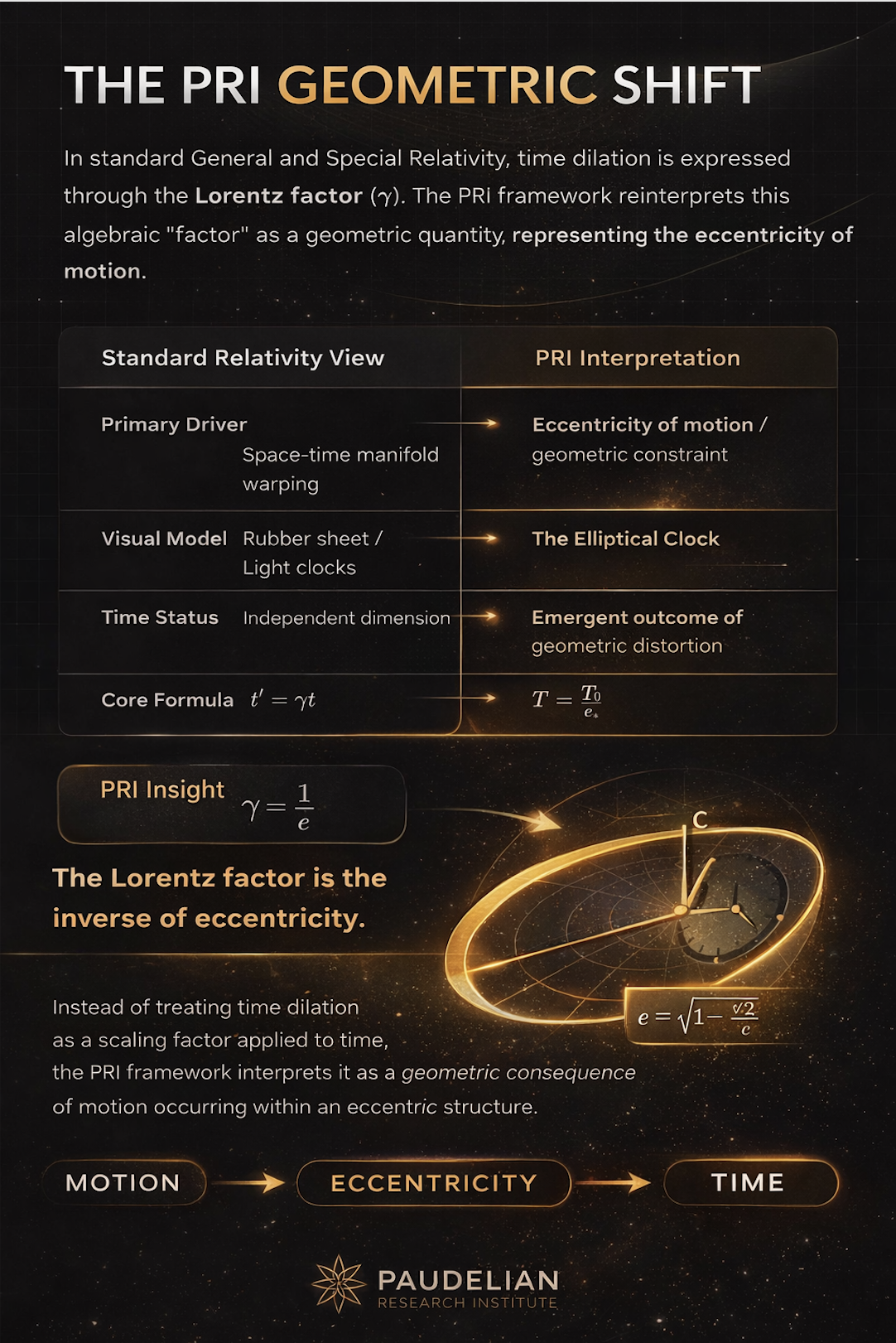
Instead of treating the Lorentz factor as an abstract number, PRI interprets it as a geometric property: the inverse of eccentricity.
From Factor to Shape
In standard explanations, the Lorentz factor appears as a scaling factor applied to time. It is usually presented algebraically, without a direct visual meaning.
PRI shifts the perspective:
What if this “factor” is actually describing the shape of motion?
In geometry, eccentricity measures how much a shape—especially an ellipse—is stretched or distorted.
A balanced, symmetric condition corresponds to low distortion
A constrained, stretched condition corresponds to higher distortion
PRI interprets motion itself as taking place within such a geometric structure.
The Key Insight
The mathematical expression inside the Lorentz factor has the same structure as the formula for eccentricity.
This leads to a powerful interpretation:
The Lorentz factor is simply the inverse of eccentricity.
In other words:
When eccentricity is close to 1 (low distortion), time behaves normally
When eccentricity decreases (greater geometric constraint), the Lorentz factor increases, and time dilation becomes more significant
What This Means Physically
PRI does not say that time slows down on its own.
Instead, it proposes:
Motion becomes geometrically constrained, and that constraint appears as time dilation.
As an object moves faster—or exists deeper in a gravitational field—its motion is no longer “free” or fully symmetric. It becomes constrained within a geometric structure that can be described as elliptical.
The more constrained this motion becomes, the more its geometry deviates from its baseline condition.
That deviation is captured by eccentricity.
And the effect we observe as time dilation is simply:
the inverse response to that geometric distortion
Connection to the PRI Gravity Framework
In the PRI framework, gravity is not just a force or a curvature—it is a generator of geometry.
Internal structure of matter produces gravity
Gravity shapes the geometry of space
Geometry constrains motion
Constrained motion produces eccentricity
Eccentricity determines time dilation
So the Lorentz factor is no longer just a mathematical tool. It becomes:
a measure of how geometry, shaped by motion or gravity, affects time
A Unified View
PRI connects motion and gravity through a single idea:
Motion (velocity) introduces geometric constraint
Gravity introduces geometric constraint
Both create eccentricity
Eccentricity governs time dilation
This leads to a unified interpretation:
Time dilation is not a primary effect—it is the visible consequence of motion within an eccentric geometric structure.
Final Insight
The Lorentz factor does not act on time. It reflects the geometry of motion. In fact, the Lorentz factor is the inverse of eccentricity.
PRI Time Dilation Is: The Eccentricity of the Clock
A Geometric Interpretation of Time
At the Paudelian Research Institute (PRI), time dilation is understood as a geometric effect of motion rather than as an independent change in time itself.
In the PRI framework, the key idea is simple:
Time does not dilate by itself. It reflects the eccentricity of motion within gravity-shaped geometry.
The Core Idea
Modern physics describes time dilation with equations that contain a square-root term. PRI interprets that term geometrically.
In geometry, eccentricity measures how stretched or distorted an ellipse is:
a circle has low distortion
a more elongated ellipse has greater distortion
PRI proposes that this same idea can be used to interpret time dilation.
The PRI Interpretation
For PRI, motion can be viewed through an elliptical clock model.
The more direct and balanced the motion, the closer the geometry is to its baseline state
The more constrained the motion becomes, the more eccentric the geometry becomes
The greater the eccentricity effect, the greater the observed time dilation
This leads to a simple interpretive statement:
Time dilation is the inverse of the eccentricity of motion.
Main Equation
T = T_0/e_*
Where:
T_0 = baseline time
T = observed time
e_* = effective eccentricity of the system
In this framework, eccentricity may arise from:
velocity, or
gravity
Velocity-Based Interpretation
In motion-based time dilation, PRI interprets the controlling factor as an eccentricity linked to the relation between actual velocity and the speed of light.
This gives a geometric reading of relativistic dilation:
As motion approaches its limiting scale, its geometry becomes more eccentric, and time dilation increases.
Gravity-Based Interpretation
PRI extends the same logic to gravity.
In gravitational environments:
motion is no longer fully direct
paths become constrained by gravity-shaped geometry
this constraint can be interpreted as an eccentricity effect
So gravitational time dilation is also read as:
a consequence of motion occurring in eccentric geometric structure
Unified PRI View
The PRI framework unifies both motion-based and gravity-based time dilation under one geometric principle:
Motion / Gravity → Geometry → Eccentricity → Time Dilation
This means that time dilation is not treated as mysterious or isolated. It is part of a larger causal chain.
The Elliptical Clock
PRI visualizes this idea through the concept of an elliptical clock.
A circular clock represents balanced, baseline motion.
An elliptical clock represents motion that has been geometrically distorted.
In this view:
a more circular condition corresponds to less dilation
a more eccentric condition corresponds to greater dilation
The clock is therefore not just a timekeeper. It becomes a geometric model of time itself.
Why This Matters
The PRI interpretation is significant because it:
gives time dilation a clear geometric meaning
connects motion, gravity, and time in one framework
preserves the mathematical form of relativity while offering a new interpretation
makes a difficult concept more visual and intuitive for readers
PRI Perspective
PRI does not treat time as changing independently. Instead, it sees time as reflecting how motion unfolds within the geometry created by velocity and gravity.
Time is not an isolated variable. It is the visible outcome of geometric distortion in motion.
Signature Statement
“Time dilation is the inverse of the eccentricity of motion.”
In Short
PRI interprets time dilation through geometry. In this view, time does not dilate by itself. Instead, motion takes place within an eccentric structure shaped by velocity or gravity. The greater the eccentricity, the greater the observed time dilation. PRI summarizes this idea in a simple relation: T = T_0 / e_*.
Abstract
PRI introduces a geometric interpretation of time dilation. Instead of viewing the Lorentz factor as an abstract quantity, it is interpreted as the inverse of eccentricity—linking motion, geometry, and time through the concept of the elliptical clock.
The PRI framework presents a unified interpretation of gravity, geometry, and time. It proposes that gravity originates from internal structural properties of matter, generates geometric distortion in space, and manifests temporally through motion constrained by that geometry. Time dilation, in this framework, is interpreted as the inverse of geometric eccentricity. By linking core-dominance gravity, curvilinear motion, and eccentricity-based time dilation, the PRI framework offers a coherent conceptual bridge between classical and relativistic physics.
Coming soon …
Gravity as Core Influence and Curvilinear Space
A PRI Framework with the 1919 Eclipse Revisited: PART 2
Abstract
The Paudel Research Institute (PRI) advances a unified view of gravity as the active influence of a Core that structures the volume around it. This influence manifests in two inseparable expressions: direct pull on matter (force) and the carving of geometric possibilities in the vacuum (curvilinear space). Together, they ensure that all propagation—massive or massless—must conform to the Core’s presence. Revisited through the canal–water analogy, the 1919 eclipse becomes a decisive demonstration of this principle: when space is curvilinear, globally straight motion does not exist.
1. The PEI Core Proposition
PRI begins with a causal statement:
Gravity is the active influence of a Core that structures the volume around it.
This influence is not passive and not merely descriptive. The Core continuously shapes its surroundings, producing two outcomes at once:
Force — how gravity is felt by matter
Geometry — how gravity is obeyed by all motion
These are not alternatives. They are dual expressions of a single origin.
2. Force and Geometry: One Cause, Two Expressions
Force (Matter’s Experience)
Material bodies accelerate toward the Core. This pull is measurable and directional. PEI does not discard force; it grounds force in the Core’s activity.
Geometry (Motion’s Constraint)
Simultaneously, the Core carves the vacuum, bending directions and removing the possibility of globally straight paths. Geometry is not a backdrop—it is made.
Force explains why matter accelerates.
Geometry explains why everything must follow curved paths.
3. The Canal–Water Analogy (Unifying Principle)
The canal–water analogy makes the unity intuitive:
The Core carves the canal.
Curvilinear space is the canal itself.
Motion (matter, light, signals) is the water.
For water with weight (matter), the canal’s slope manifests as force-like acceleration.
For weightless flow (light), the canal still dictates direction—without any pull.
Thus, force and geometry are not competing explanations; they are two readings of the same carved structure.
4. “In Curvilinear Space, Straight Motion Does Not Exist”
This PEI statement is geometric, not rhetorical.
Locally, motion may proceed “straight ahead.”
Globally, once space is curved, rectilinear paths are unavailable.
Motion does not become curved; it is born into curvature.
Ask why a flow curves in a canal. The answer is final: there is no straight channel available.
5. The 1919 Eclipse as a Geometric Demonstration
During the Solar Eclipse of 1919, expeditions led by Arthur Eddington observed that starlight passing near the Sun appeared displaced from its usual positions.
The canonical conclusion was that gravity bends light.
PEI asks a prior question: what was the geometry of space through which that light traveled?
6. Reframing the Eclipse with the Canal–Water Analogy
The Sun as Canal-Carver
The Sun’s Core pre-structures space around it. This curvature exists whether or not light passes through.
Light as Water
Starlight approaches inertially. When it enters the Sun’s gravitational region, it enters a curved canal.
Why the Light Curved
Not because it was pushed or pulled sideways—but because no straight path existed in that region of space. The light followed the straightest paths available within the curved canal.
The eclipse did not show light reacting to gravity.
It showed geometry revealing itself through motion.
7. What the Telescope Actually Measured
The observed stellar displacement was a geometric signature, analogous to inferring a canal’s shape by watching water flow. The instrument detected not force acting on photons, but curvature constraining propagation.
From the PEI standpoint, the word bending misleads:
Water does not bend in a curved canal.
It flows naturally along the canal’s shape.
So did the light.
8. The Vacuum as Structured Possibility
PEI treats the vacuum not as emptiness, but as a field of geometric possibilities continuously shaped by the Core.
Gravity defines which directions exist.
Space becomes a navigable volume only after being structured.
Without the Core, curvature collapses toward flatness—and guided motion disappears.
Space is the consequence of gravitational structuring.
9. Resolving the Force–Geometry Divide
PEI avoids a false choice:
Gravity is not only force.
Gravity is not only geometry.
Gravity is the Core’s active influence—
force for matter, geometry for motion—
unified by one cause.
Force without geometry is blind.
Geometry without activity is empty.
Conclusion
This flagship PEI framework reframes gravity as an active Core influence that simultaneously pulls matter and sculpts space. The 1919 eclipse, revisited through the canal–water analogy, becomes a clean demonstration of the central claim: in curvilinear space, globally straight motion does not exist. Light did not deviate; it faithfully followed geometry.
Gravity, here, is not an external actor nor a passive metric.
It is the structuring act that makes force and geometry possible.
In Curvilinear Space, Rectilinear Motion Does Not Exist
The 1919 Eclipse Revisited Through the Canal–Water Analogy: PART 1
Abstract
The 1919 solar eclipse observations are commonly cited as evidence that gravity bends light. Within the Paudel Research Institute (PRI) framework, this phenomenon is interpreted more fundamentally: gravity forms curvilinear space, and in such space globally straight motion does not exist. Light did not “bend” in response to a force; it followed the only geometrically available paths. This section reframes the eclipse using the canal–water analogy, clarifying why curved trajectories are not reactions but necessities.
1. The Observational Event
During the Solar Eclipse of 1919, expeditions led by Arthur Eddington photographed stars whose light passed close to the Sun. The stars appeared displaced from their usual positions, indicating that the light’s path near the Sun differed from its path in regions far away.
The conventional reading states that gravity deflected light.
PEI asks a prior question: What was the geometry of space through which that light traveled?
2. The PEI Principle
PEI begins with a geometric axiom:
Gravity forms curvilinear space.
From this, a strict consequence follows:
In curvilinear space, straight motion does not exist.
“Straight” here refers to a global, rectilinear path. Once space itself is curved, such paths are unavailable. Motion can be locally straight—step by step—but globally it must conform to the curvature of space.
3. Gravity as the Canal
The canal–water analogy makes this unavoidable logic intuitive.
A canal is a pre-existing geometric structure carved into terrain.
Its curvature exists regardless of whether anything flows through it.
The canal does not act on water; it defines the path water can take.
In the PEI framework, the Sun’s gravity is the canal. It shapes space into a curved geometry surrounding it. This geometry exists before light arrives and independent of it.
4. Light as the Water
Starlight approaching Earth during the eclipse is the water.
Light travels inertially.
It does not steer, correct, or decide.
When it enters the Sun’s gravitational region, it enters a curved spatial canal.
The light then follows the canal—not because it is pushed or pulled, but because no straight channel exists within that geometry.
5. Why the Light Had No Straight Option
A natural question arises: Why didn’t the light continue straight?
Within the PEI interpretation, the answer is simple and final:
There was no straight path available in that region of space.
In curvilinear space:
Parallel paths can converge.
Directions themselves are bent.
What appears as “deflection” from afar is obedient motion within geometry.
The light did not change direction; it maintained inertial motion along the straightest paths permitted by the curved canal.
6. What the Eclipse Actually Revealed
The eclipse did not show light being acted upon.
It showed space revealing its shape through motion.
The observed stellar displacement was a geometric signature:
Not evidence of photons responding to force
But evidence that space near the Sun is not rectilinear
Just as observing curved water flow reveals the shape of a canal, observing curved light paths revealed the curvature of space.
7. Reframing “Bending”
From the PEI standpoint, the word bending is misleading.
Water does not bend in a curved canal.
It flows naturally along the canal’s shape.
Likewise:
Light did not bend at the Sun.
It followed the geometry that gravity had already imposed.
Curvature is not an effect of motion.
Curvature is the condition of motion.
8. Conceptual Implications
The 1919 eclipse can therefore be restated as follows:
When gravity forms curvilinear space, straight motion ceases to exist as a global possibility.
Motion—whether of mass or light—becomes a tracer of geometry.
This reframing shifts explanation from interaction to structure, from force to form.
Conclusion
Reinterpreted through the PEI framework, the 1919 eclipse demonstrated not that gravity acts on light, but that space near massive bodies is inherently curvilinear. In such space, motion cannot be globally straight. Light followed its path perfectly—not by reacting to gravity, but by obeying geometry.
Gravity, in this view, is not an external agent.
It is the canal of space itself, and motion—like water—has no option but to follow its curves.
Why PRI Is Not a Newtonian Framework
The PRI explicitly rejects the idea that its gravity framework is a return to Newtonian physics. While PRI restores gravity as a real, active force, its assumptions, scope, and cosmology differ fundamentally from Newton’s model.
This article clarifies those differences, addresses common objections, and situates PRI as a distinct third framework, not a regression.
1. Superficial Similarity: “Gravity as a Force”
It is true that both Newtonian gravity and PRI:
Treat gravity as real and active
Allow gravity to bend trajectories
Reject geometry as the source of gravity
This resemblance is terminological, not foundational.
Calling PRI “Newtonian” on this basis is misleading, because Newtonian gravity ends exactly where PRI begins asking deeper questions.
2. Newtonian Gravity: What It Actually Assumes
Newtonian gravity rests on four core assumptions:
Absolute, infinite, flat space
Instantaneous action at a distance
Gravity acts between masses
No cosmology (no origin, no expansion)
Newton explains how masses attract—but not:
why geometry exists,
how space is structured,
or how the universe began or evolves.
Newton has no Big Bang, no expansion, and no global narrative.
3. PRI’s First Fundamental Break:
Gravity Determines Geometry
Newton:
Geometry is fixed and irrelevant.
PRI:
Geometry exists and is determined by gravity.
PRI introduces two geometric conditions of space:
Rectilinear space (no gravity)
Curvilinear space (with gravity)
Geometry is not assumed—it emerges.
This alone places PRI outside Newtonian philosophy, which never engages geometry at all.
4. Explicitly Addressing the Shell Theorem / Accretion Objection
A common objection is:
If gravity comes from a core, doesn’t the shell theorem imply that outer layers cancel out gravity?
Newtonian Shell Theorem (What It Actually Says)
The shell theorem states:
A perfectly symmetric shell exerts zero net force inside it
Gravity depends only on enclosed mass
This is a mathematical result, not a statement about physical cores, formation, or causality.
Why This Does Not Contradict PRI
PRI does not claim:
Gravity arises from arbitrary shells
Gravity is produced by symmetry alone
Gravity is simply mass summation
Instead, PRI proposes:
Gravity is associated with a centralized, organizing core
Accretion occurs toward this core
Symmetry is the result of gravity, not its cause
In PRI:
The shell theorem describes a stable outcome
It does not describe the origin of gravitational influence
Accretion presupposes gravity; it does not generate it.
Thus:
Shell equilibrium is a consequence of gravity, not its explanation.
Newtonian mathematics describes equilibrium states.
PRI addresses why such equilibria exist at all.
5. PEI’s Second Fundamental Break: Cosmology
Newtonian physics has no cosmology.
It cannot explain:
The origin of motion
Expansion
Large-scale structure
PRI explicitly does.
6. PRI Cosmology: Inertial Expansion (Firecracker Analogy)
PRI proposes that cosmic expansion is best understood as inertial continuation, not metric stretching.
The Firecracker Analogy
A firecracker explodes
Fragments fly outward
No space is stretching between fragments
Motion continues due to inertia
PRI applies this logic to the universe:
The Big Bang was a primordial energetic event
Matter was ejected outward
Expansion continues due to initial momentum
Gravity later organizes matter into cores and structures
This is fundamentally non-Newtonian:
Newton has no Big Bang
No inertial cosmology
No expansion narrative
7. Why PRI Prefers Inertial Expansion Over Metric Stretching
PRI finds inertial expansion conceptually cleaner because:
It preserves causality
It avoids reifying space as an elastic substance
It explains why expansion slows locally (gravity)
It aligns with structure formation intuitively
In PRI:
Space does not stretch itself.
Matter moves because it was set in motion.
Metric expansion is treated as a descriptive model, not a physical engine.
8. Final Clarification (Canonical PEI Statement)
PRI restores gravity as a force, but it is not Newtonian.
It determines geometry, treats space as contextual, and provides a non-metric cosmology rooted in inertial expansion.
PRI in One Line
Newton explains local force.
Einstein explains geometric description.
PRI explains causal origin—from the Big Bang to gravity itself.
Two Types of Space:Rectilinear and Curvilinear
Abstract
PRI proposes that space exists in two fundamentally different geometric conditions depending on the presence or absence of gravity. In the absence of gravity, space is rectilinear—motion is straight and geometry is flat. In the presence of gravity, space becomes curvilinear—motion bends and geometry appears curved. This article presents the PRI framework in clear, non-technical terms and explains why geometry is treated as a consequence of gravity rather than its cause.
1. Introduction
Most modern discussions of gravity assume that space itself is inherently curved. PRI takes a different starting point.
PRI proposes that space has no fixed geometry of its own. Instead, its geometry depends entirely on whether gravity is present.
From this perspective, there are two types of space:
Rectilinear space — space without gravity
Curvilinear space — space under gravitational influence
These are not different universes or substances, but two geometric conditions of the same space.
2. Rectilinear Space: Space Without Gravity
Rectilinear space is the default condition of space when no gravitational influence exists.
In rectilinear space:
Motion proceeds in straight lines
Directions are uniform and globally consistent
Parallel paths never converge
Geometry is flat (Euclidean)
No natural curvature exists
Rectilinear space is not imposed by assumption. It is observed whenever nothing bends motion.
In PRI’s framework:
Flat space is what remains when gravity is absent.
3. Curvilinear Space: Space With Gravity
Curvilinear space emerges wherever gravity acts.
Gravity, in PRI, is a real, active force emanating from a core—planetary, stellar, or galactic. This force continuously bends motion toward the core.
As a result:
Straight-line motion is deflected
Paths become curved
Directions lose symmetry
Geometry appears non-Euclidean
When all motion within a region bends in a systematic way, observers naturally describe that region as curved space.
PRI emphasizes:
Space does not bend motion.
Gravity bends motion, and space appears curved as a result.
4. Geometry as an Effect, Not a Cause
A central principle of PRI is causal discipline:
Forces act
Motion responds
Geometry records the outcome
Geometry is therefore descriptive, not generative.
Curvilinear geometry does not create gravity.
It is the visible imprint of gravity’s action.
This distinction allows PRI to accept geometric descriptions without assigning them physical agency.
5. Transition Between the Two Types of Space
Rectilinear and curvilinear space are not separate realms. Space transitions smoothly between them as gravitational influence changes.
Near a massive core → strongly curvilinear
Far from the core → weakly curvilinear
Beyond influence → rectilinear
This leads to a key PRI definition:
Curved Space is a volume of gravitational influence.
Where influence fades, curvature fades.
6. Application to Earth and the Cosmos
Under the PRI framework:
Earth’s surrounding space is curvilinear because Earth’s core exerts gravity
If that gravitational influence were removed, space would immediately revert to rectilinear
No geometric “fabric” needs to adjust—motion simply straightens
At cosmic scales:
Galaxies create curvilinear regions around their cores
Intergalactic regions approach rectilinear space
The universe contains both types simultaneously, depending on influence
7. Relationship to Existing Theories
PRI does not reject classical or modern physics. It reorders causality.
Newton described gravity as a force in flat space
Einstein described gravity through curved geometry
PRI proposes: gravity determines geometry
This preserves observation while restoring intuitive cause-and-effect reasoning.
8. Conclusion
PRI’s proposal of two types of space offers a simple, unified framework:
Rectilinear space exists where gravity is absent
Curvilinear space exists where gravity acts
Geometry follows force, not the other way around
By treating space as responsive rather than autonomous, PRI provides a coherent explanation from cosmic scales to local motion—without adding unnecessary assumptions.
PRI Summary Statement
Without gravity, space is rectilinear.
With gravity, space becomes curvilinear.
Geometry reflects gravity’s action—it does not create it.
The Eclipse of 1919 Explained Through the PRI Framework
The 1919 solar eclipse is famous because it showed that starlight passing near the Sun appears slightly shifted from its normal position. This was widely interpreted as proof that space itself is curved.
PRI accepts the observation—but reinterprets the cause.
What Was Observed (Agreed by All Frameworks)
During the eclipse:
Stars near the Sun appeared slightly displaced
The displacement matched predictions
The effect occurred only near the Sun
The effect vanished away from the Sun
This is not disputed.
What differs is why it happened.
The Standard Interpretation (Briefly)
The traditional explanation says:
The Sun curves spacetime
Light follows the curved geometry
The apparent bending is due to space itself being curved
This interpretation assigns geometry as the cause.
The PRI Interpretation: Gravity Acts First
PRI proposes a different causal order:
The Sun’s gravity bends trajectories directly.
Geometry is inferred afterward.
In PRI:
Light always tries to move straight
Gravity is an active influence emanating from the Sun’s core
As light passes through this gravitational influence, its path is deflected
The collection of bent paths is later described as “curved space”
Why Light Bends Near the Sun (PRI View)
According to PRI:
Light has direction and momentum
Gravity acts on anything that propagates
Near a massive core, gravity continuously redirects motion
The closer the path, the stronger the deflection
Thus:
Light bends because gravity acts
Not because space forces it to bend
Why the Eclipse Was Essential
Normally, the Sun’s brightness hides background stars.
The eclipse:
Blocked the Sun’s light
Revealed background stars
Allowed measurement of deflection
The eclipse did not cause bending—it simply made the effect visible.
Geometry as a Description of the Result
PRI emphasizes this distinction:
Observers see bent paths
They draw curved geometry to describe them
Geometry summarizes the effect of gravity
Geometry does not produce the effect
In PRI terms:
Curved space is the map, not the engine.
A Simple Analogy (PRI-Style)
Imagine wind bending the path of smoke:
Smoke tries to rise straight
Wind pushes it sideways
The resulting path curves
Later, someone draws curved arrows to represent airflow.
Those arrows did not bend the smoke—the wind did.
Gravity plays the role of wind.
Geometry plays the role of arrows.
Why the Result Matches Einstein’s Numbers
PRI acknowledges:
Einstein’s equations predicted the magnitude correctly
Geometry is an excellent mathematical language
Descriptions can be accurate even if causality is reassigned
PRI does not deny the math.
PRI reframes the meaning.
PRI Summary of the 1919 Eclipse
The 1919 eclipse showed that gravity bends light.
PRI proposes that geometry was inferred from this bending—not responsible for it.
Or more succinctly:
Light bent because gravity acted,
and space appeared curved because motion was bent.
Why This Matters for PRI
This reinterpretation:
Preserves the observation
Restores gravity as an active force
Keeps geometry descriptive
Aligns with PRI’s broader causal philosophy
Bridges intuition and observation
PRI One-Line Principle (Eclipse Context)
The eclipse revealed gravity’s action, not space’s intention.
The earth would be “flat” — rectilinear — without Gravity
When PRI says:
“The Earth would be flat without gravitational influence from the core”
It means:
No inward bending of motion
No natural curvature imposed on paths
No spherical geometry enforced
It does not mean Earth would look like a flat object.
It means Earth’s surrounding space would be geometrically flat, rectilinear, because nothing would bend motion.
Why This Clarification Matters
PRI emphasizes this definition because:
It prevents confusion with popular or historical claims
It keeps the discussion grounded in geometry and physics
It aligns gravity, motion, and space into a single causal chain
PRI’s framework consistently follows this order:
Gravity acts → motion bends → geometry appears → space is described
The PRI Definition
Flat Earth (PRI):
A condition of rectilinear space in which gravity is absent and motion remains straight.
At PRI, we explore ideas by asking simple but foundational questions. One such question is this:
What would the Earth look like if there were no gravitational influence from its core?
PRI’s view is direct and intuitive:
If there were no gravitational influence from Earth’s core, the Earth would be flat in its geometry and behavior.
This statement is not about maps or appearances—it is about how geometry itself emerges from gravity.
1. What PRI Means by “Flat”
When PRI uses the word flat, it does not mean that Earth would look like a disk.
Instead, flat means:
No curvature imposed on motion
No bending of paths
No natural tendency for objects to follow arcs or orbits
In other words, motion would be rectilinear, and geometry would be Euclidean.
Flatness, in PRI, refers to behavior, not shape.
2. Gravity as the Source of Curvature
In the PRI framework, gravity is an active influence emanating from a core. This influence continuously pulls matter inward and bends the motion of objects near it.
Because of gravity:
Falling objects curve toward Earth
Satellites follow arcs
Oceans conform to a spherical surface
Directions subtly converge toward the core
This constant bending is what gives rise to curvature.
3. Remove the Core, Remove the Curvature
Now consider a PRI thought experiment:
The Earth’s material shell remains
The gravitational core disappears
No force pulls inward
What happens?
Objects no longer fall
Paths straighten immediately
No natural curvature remains
Geometry becomes flat by default
Nothing needs to “rearrange” itself.
Flatness simply reappears once gravity is gone.
4. Geometry as a Consequence, Not a Cause
PRI emphasizes a crucial distinction:
Geometry does not create gravity
Geometry records gravity
Curvature is not a hidden structure forcing objects to move.
It is the visible outcome of gravity bending motion everywhere within its reach.
Just as ripples reveal wind but do not create it, curvature reveals gravity but does not generate it.
5. Why the Earth Appears Curved Today
The Earth appears curved because:
Gravity pulls equally toward the core from all directions
Matter settles into symmetrical balance
Motion continuously bends inward
This produces a spherical equilibrium.
But in PRI’s view, this shape is achieved, not assumed.
6. Space as a Volume of Influence
PRI defines space around Earth as the region influenced by Earth’s gravity:
Strongest at the core
Weakening outward
Eventually fading into flatness
Where gravity dominates, curvature dominates.
Where gravity disappears, flatness returns.
7. Why This Idea Matters
This perspective matters because it:
Restores gravity as a primary force
Treats geometry as descriptive rather than causal
Offers a simpler intuition for non-specialists
Aligns physics with common experience of motion
It also connects seamlessly with PRI’s broader philosophy across science and economics:
forces act first; patterns appear second.
PRI Summary Statement
The Earth is curved because gravity acts.
Remove gravity, and geometry flattens.
A Note to Readers and Supporters
The Paudel Research Institute’s mission is not to overturn science, but to clarify it—to revisit fundamental assumptions with patience, intuition, and respect for evidence. By asking what causes what, we aim to build frameworks that are accessible, testable, and conceptually coherent.
Gravity as the Source of Curvature, not curvature as the source of gravity
Abstract
Modern physics commonly holds that gravity arises from the curvature of space (or spacetime). Paudelian Research Institute proposes a complementary but causally reversed interpretation: space appears curved because gravity warps it. In the absence of gravity, PRI argues, space is flat and rectilinear. Curvature is not a pre-existing property of space, but a geometric consequence inferred from gravitational influence. This article presents the PRI framework in intuitive, non-technical terms.
1. Introduction
The relationship between gravity and geometry has long been one of the most profound questions in physics. Classical mechanics treated gravity as a force acting within flat space. Relativity reframed gravity as curvature of spacetime itself.
PRI does not reject the empirical success of either view. Instead, it asks a more foundational question:
What comes first—curvature or gravity?
PRI proposes a simple but radical answer:
Gravity precedes curvature.
2. Flat Space in the Absence of Gravity
In the PRI framework, consider a universe with no gravity whatsoever.
In such a universe:
Objects move in perfect straight lines
Directions are uniform and globally consistent
Parallel paths never converge or diverge
Geometry is Euclidean and rectilinear
There is no reason for curvature to exist, because nothing bends motion. Space, in this condition, is best described as flat—not as an assumption, but as an observational consequence of unbent trajectories.
Key point:
Flatness is not imposed; it emerges naturally when gravity is absent.
3. Gravity as an Active Distorting Influence
PRI defines gravity as a real, active influence emanating from a core—planetary, stellar, or galactic. This influence continuously alters motion.
When gravity is present:
Straight-line motion is deflected
Trajectories become curved
Directional symmetry is broken
Paths that would otherwise be linear are forced into arcs
Importantly, PRI emphasizes that objects still attempt to move straight. The curvature is not voluntary; it is imposed by gravity.
4. Why Space Appears Curved
Geometry, in PRI, is not primary—it is inferred.
Observers infer the nature of space by studying motion:
If motion is straight everywhere → space is flat
If motion curves everywhere → space appears curved
Thus, when gravity bends all trajectories within a region, the most natural geometric description of that region becomes curvilinear.
PRI conclusion:
Space looks curved because gravity bends motion, not because space itself forces motion to bend.
5. Thought Experiment: Gravity Removed
Imagine a planet whose gravitational core suddenly vanishes while its outer shell remains.
Under PRI logic:
Orbits instantly cease
Trajectories straighten
No bending remains
Geometry reverts to flatness
Nothing about space itself needed to “relax.” Curvature disappeared solely because gravity disappeared.
This reinforces the PRI claim that curvature is dependent, not autonomous.
6. Conclusion
The PRI framework offers a simple reinterpretation with profound implications:
Without gravity, space is flat because motion is unbent
With gravity, space appears curved because motion is bent
Geometry is descriptive, not causative
Gravity is primary; curvature is derivative
This view preserves observational facts while offering a different explanatory hierarchy—one that restores gravity as an active force and geometry as its visible signature.
PRI Summary Statement
Space does not curve motion.
Gravity bends motion—and space appears curved as a result.
A Common Question: Why Does Space Look Curved?
You may have heard that gravity exists because space is curved. PEI invites you to consider the reverse:
What if space looks curved because gravity warps the space?
This small change in perspective leads to a surprisingly clear picture of the universe.
Imagine a World Without Gravity
Picture a universe with no gravity at all.
Objects move straight forever
Directions are simple and consistent
Nothing bends, nothing curves
Space behaves like a perfectly flat grid
In such a world, there is no reason to talk about curvature. Space is flat—not by assumption, but because nothing distorts motion.
What Gravity Changes
Now introduce gravity.
Gravity pulls, deflects, and redirects motion. Objects that would normally travel in straight lines are gently bent toward planets, stars, and galaxies.
As a result:
Paths become curved
Orbits form
Motion no longer looks straight
When everything moves this way, our natural conclusion is that space itself must be curved.
PRI’s insight is simple:
Space appears curved because gravity bends everything moving through it.
Geometry as a Record, Not a Cause
PRI sees geometry as a record of influence, not the source of it.
Think of tire tracks in snow:
The tracks show where the car went
They did not cause the car to move
In the same way:
Curved paths reveal gravity’s presence
They do not create gravity themselves
Space reflects what gravity is doing.
A Thought Experiment
Imagine Earth suddenly losing its gravitational center.
What would happen?
Orbits would disappear
Paths would straighten
Curvature would vanish
Space would instantly appear flat again—not because space changed, but because gravity was gone.
How PRI Thinks About Curvilinear Space
PRI proposes that space is best understood as a region of influence.
Earth’s space extends as far as Earth’s gravity reaches
A galaxy’s space extends as far as its core influence
Where gravity fades, flatness returns
In this view:
No gravity → no curvature → flat space
Why This Matters
This idea does not discard modern physics—it reframes it.
By restoring gravity as an active force and viewing geometry as its visible signature, PRI opens new ways of thinking about:
Motion and structure
Planetary systems
The nature of space itself
Sometimes progress comes not from adding complexity, but from restoring clarity.
The PRI Perspective in One Line
Gravity bends motion.
Space looks curved because of it.
A Note to Supporters
PRI exists to explore bold ideas carefully, responsibly, and independently. Your support allows us to develop intuitive frameworks that bridge science, philosophy, and public understanding—without rushing, overselling, or politicizing discovery.
**Gravity First, Geometry Second:
How This Idea Fits the PRI Gravity Framework**
At the Paudelian Research Institute (PRI), our work on gravity follows a single guiding principle:
Start with what acts.
Then describe what appears.
This article aligns directly with PRI’s other gravity writings, including:
Geometry as the Consequence of Gravity
Space as a Volume of Influence
Straight Motion Appears Curved Under Gravity
No Core → No Gravity → No Space
1. Motion Comes First in PRI
Across all PRI gravity articles, one assumption is constant:
Objects always try to move straight.
This is not a mathematical preference—it is an observational one. When nothing interferes, motion is linear, direct, and rectilinear.
PRI therefore begins with motion, not geometry.
2. Why PRI Says Space Is Flat Without Gravity
In earlier PRI articles, we state:
Without gravity, there is no curvature.
This follows naturally:
No gravitational pull
No bending of paths
No reason for space to appear curved
Flat space is not an abstract assumption—it is what remains when nothing distorts motion.
This aligns with PRI’s view that geometry is inferred, not imposed.
3. Gravity as the Source of Apparent Curvature
PRI defines gravity as a real influence emanating from a core—planetary, stellar, or galactic.
When gravity is present:
Motion is continuously redirected
Straight paths appear curved
Orbits emerge naturally
This is why PRI consistently writes:
Straight motion looks curved in the presence of gravity.
The curvature belongs to motion, and space reflects it.
4. Geometry as Description, Not Cause
In multiple PRI publications, we emphasize that geometry is descriptive.
Just as:
Weather maps do not cause storms
Seismographs do not cause earthquakes
Geometry does not cause gravity.
Instead:
Curved geometry records gravitational influence
It is a language for summarizing motion
This explains why PRI treats geometry as an effect rather than a mechanism.
5. Curved Space as a Volume of Influence
This article also aligns with PRI’s definition of space:
Curved space is the region where gravity meaningfully acts.
Examples already discussed in PRI work:
Earth’s space extends from its crust to its exosphere
A galaxy’s space extends as far as its core influence
Where influence fades, curvature fades
Thus:
Space is not infinite by default
Curvature is localized
Flatness dominates where gravity is absent
6. The Core Thought Experiment Revisited
PRI frequently uses the following thought experiment:
If a gravitational core disappears, curvature disappears with it.
Nothing else needs to change.
No hidden fabric must “relax”
No geometry must “update”
Motion simply straightens
This thought experiment unifies PRI’s views on gravity, space, and geometry.
7. How This Differs—Without Opposition
PRI does not aim to dismantle existing theories.
Instead, it offers a reframing:
Observations stay the same
Explanations shift
Causality is reordered
Gravity becomes primary, geometry becomes secondary, and space becomes contextual.
8. Why PRI Pursues This Direction
Across physics, economics, and systems thinking, PRI follows one consistent philosophy:
Effects should not be mistaken for causes.
Just as prices reflect economic pressure rather than create it, geometry reflects gravitational influence rather than generate it.
This conceptual symmetry is intentional and foundational to PRI’s interdisciplinary approach.
Two Thought-Experiment Analogies in the PRI Framework
How PRI thinks about gravity and cosmic expansion
The Paudel Research Institute (PRI) uses thought-experiment analogies not as literal physical claims, but as conceptual tools. Their purpose is to help readers separate observation from interpretation, and to explore alternative ways of understanding familiar phenomena.
Two such analogies play a central role in PRI’s current thinking:
the clay-sphere with an invisible magnet, and
the firecracker explosion analogy for cosmic expansion.
Together, they illustrate how PRI approaches gravity and the large-scale behavior of the universe.
1. The clay-sphere analogy: gravity as a generated influence
The first analogy imagines a clay sphere with an invisible magnet at its center. From the outside, the sphere appears uniform. Yet iron particles placed nearby are drawn inward—not by the clay itself, but by the unseen magnet inside.
PRI uses this analogy to distinguish:
what is visible from
what generates force.
In this framework:
the magnet represents an internal generative core,
the clay represents accumulated matter (dust, debris, shell),
attraction originates from the core, not the exterior mass.
This analogy helps explain why PRI separates source from appearance in its gravity framework. It does not claim gravity is magnetic; it simply illustrates that forces need not originate in what is externally observed.
2. The firecracker analogy: expansion as ongoing motion
The second analogy addresses a different question:
Why do galaxies appear to be moving away from one another?
PRI invites readers to imagine a firecracker exploding in open space.
When the explosion occurs:
fragments are violently ejected outward,
each fragment continues moving due to inertia,
long after the explosion, the fragments are still separating.
At any later moment, an observer measuring distances between fragments would conclude that:
“Everything is moving away from everything else.”
Yet crucially:
space itself is not expanding,
no new explosion is occurring,
the motion is simply the continuation of an initial ejection.
3. PRI’s interpretation of cosmic expansion
Within PRI’s framework, the observed expansion of the universe is interpreted analogously.
PRI proposes that:
the Big Bang was a cosmic apocalypse, an unimaginably large explosive event,
matter and gravitational cores were ejected outward at extreme velocities,
the current expansion reflects ongoing motion, not ongoing creation of space.
In this view:
the universe is not expanding in the sense of space stretching,
rather, the contents of the universe are still in motion,
cosmic expansion is a kinematic aftereffect, not a dynamic stretching of spacetime.
This interpretation reframes expansion as continued scattering, not continuous expansion.
4. How this differs from the standard spacetime view
In standard cosmology, expansion is usually described as:
space itself expanding,
galaxies remaining locally at rest while space stretches between them.
But PRI asks:
Is expansion necessarily a property of space, or could it be a legacy of initial motion?
The firecracker analogy illustrates that increasing separation does not uniquely imply expanding space. Separation can also arise from sustained inertial motion following an initial event.
5. Why PRI uses analogies at all
PRI’s analogies are not meant to replace equations or observations. Their purpose is different:
to challenge hidden assumptions,
to show that familiar observations can admit multiple coherent interpretations,
to encourage foundational questioning rather than immediate conclusions.
Just as the clay-sphere analogy separates force generation from visible mass, the firecracker analogy separates expansion from motion.
6. A unified perspective
Together, the two analogies express a consistent PRI philosophy:
Gravity originates from internal generative structures, not accumulated shells.
Cosmic expansion reflects the enduring consequences of a primordial event, not necessarily the stretching of space itself.
In both cases, PRI emphasizes origin over description, cause over appearance, and process over assumption.
Closing perspective
PRI does not claim that these analogies disprove existing theories. Instead, they serve as conceptual lenses—ways to think differently about gravity and cosmic expansion without dismissing what has already been learned.
Whether these perspectives ultimately prove fruitful is an open question. What matters is that they expand the space of inquiry. And in science, asking new questions has often been the first step toward deeper understanding.
What Einstein’s Framework Says—and What PRI Says Beyond It
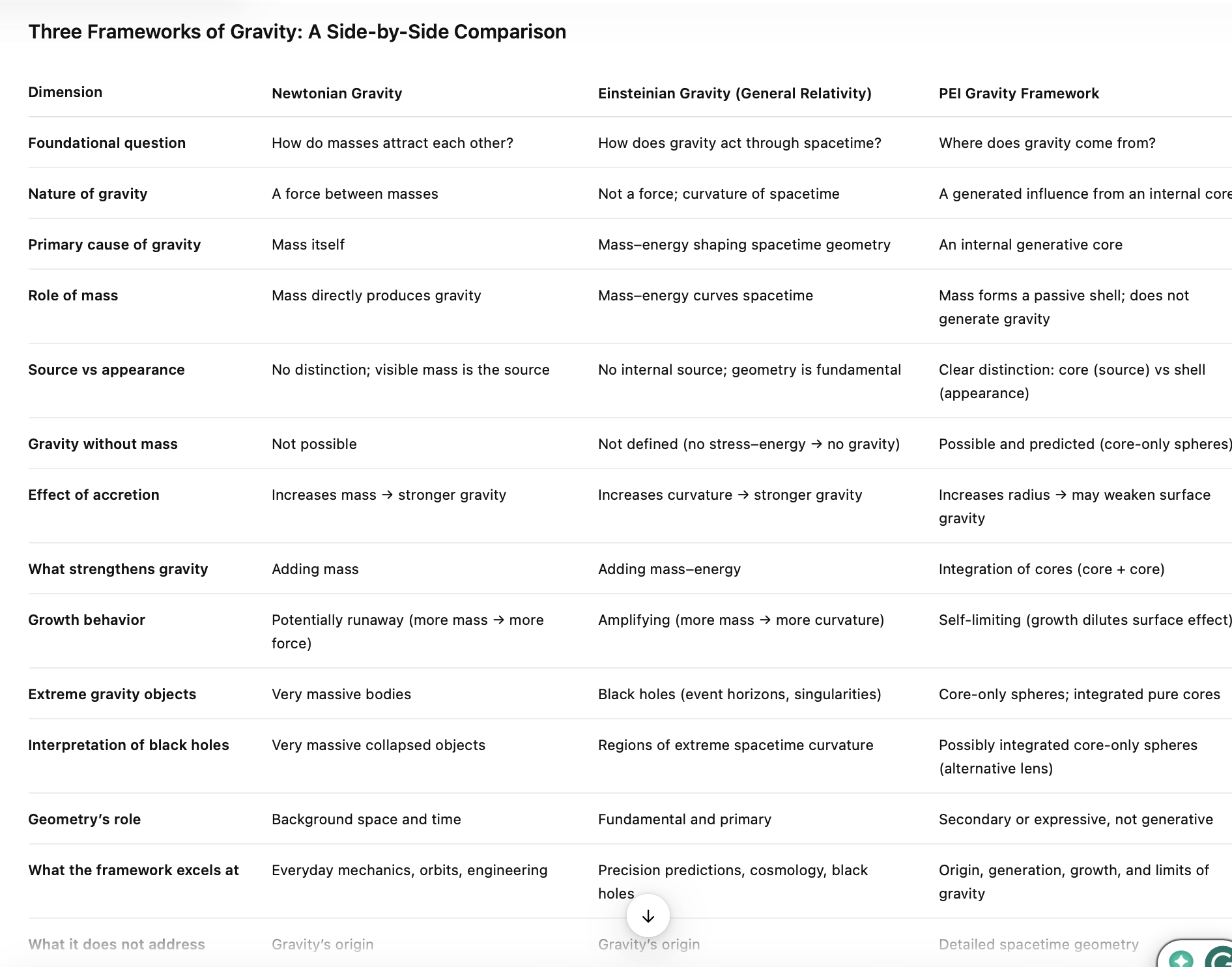
Three Frameworks of Gravity: A Side-by-Side Comparison. GPT’s Side-by-side comparison of the three gravity frameworks—Newtonian, Einsteinian, and PEI’s core-sourced framework—for readers who want to understand how they differ without ranking or dismissing any of them.
A reader-friendly explanation of two distinct ways of thinking about gravity
Paudel Research Institute (PRI) approaches gravity from a different starting point than the familiar Einsteinian framework. This article is written for general readers who may wonder: If Einstein already explained gravity so successfully, what exactly is PEI trying to say—and why is it different?
The answer lies not in disagreement, but in scope.
What the Einsteinian framework says
Einstein’s theory of gravity, known as general relativity, is one of the most successful scientific frameworks ever developed. At its heart is a simple but powerful idea:
Gravity is not a force produced by an object, but an effect of curved spacetime.
According to this view:
Mass and energy tell spacetime how to curve.
Curved spacetime tells objects how to move.
Planets orbit stars, and light bends near massive bodies, because spacetime itself is shaped by mass–energy.
Einstein’s framework excels at describing:
motion of planets and satellites,
gravitational lensing,
time dilation near massive objects,
black holes and cosmic dynamics.
In short, it tells us how gravity behaves with extraordinary precision.
What the Einsteinian framework does not try to say
Equally important is what Einstein’s framework does not attempt to explain.
General relativity does not ask:
Why does gravity exist at all?
What produces gravity in the first place?
Is gravity generated by something deeper than geometry?
This silence is intentional. Einstein’s theory treats spacetime geometry as fundamental. Gravity is not something that needs a generator—it is the geometry.
For most purposes, this is not a limitation. It is simply a design choice.
Where the PRI framework begins
PRI begins precisely where Einstein’s framework remains silent.
Instead of asking how gravity acts, PRI asks:
What generates gravity?
In the PRI framework:
Gravity is produced by an internal generative core associated with astronomical bodies.
Accumulated matter—dust, debris, and mass—forms an exterior shell that responds to gravity but does not create it.
Gravity can exist before, without, or independent of visible mass accumulation.
This does not contradict Einstein’s equations. It addresses a different level of explanation.
Source versus geometry
A helpful way to understand the distinction is this:
Einstein’s framework describes gravity as geometry.
PRI’s framework describes gravity as having a source.
Einstein explains how spacetime curves once gravity exists.
PRI explores what might generate gravity before geometry is considered.
These are not competing answers to the same question—they are answers to different questions.
Accretion, growth, and gravity
Another key difference lies in how growth is interpreted.
In the Einsteinian view:
Adding mass increases spacetime curvature.
Accretion strengthens gravity.
In the PRI framework:
Accretion adds a passive shell.
The gravitational core does not become stronger.
Growth increases radius, which can weaken observable gravity at the surface.
However, PRI introduces a separate mechanism for strengthening gravity:
core–core integration.
When gravitational cores merge, the combined core can have greater generative capacity. This is fundamentally different from adding passive mass.
Extreme gravity and black holes
Einstein’s framework describes black holes as regions of extreme spacetime curvature, defined by event horizons and relativistic geometry.
PRI offers an alternative lens:
Some extremely strong gravitational objects may be core-only spheres—objects dominated by a powerful internal core with little or no surrounding shell.
Such objects can appear dark and gravitationally dominant, much like black holes.
The difference lies not in observation, but in explanation.
PRI does not claim black holes are “wrong.” It suggests that another coherent explanation is possible under different assumptions.
Gravity without visible mass
One of the most striking implications of the PEI framework is that gravity can exist without accumulated mass.
In Einstein’s theory:
No mass–energy means no curvature, and therefore no gravity.
In PRI’s framework:
Gravity originates in the core.
Mass accumulation is conditional on environment.
A gravitational object may exist in a nearly pure state, with little or no visible matter.
This idea aligns with growing curiosity in physics about whether gravity is more fundamental than matter itself.
Two frameworks, two roles
It is best to think of the two frameworks as addressing different layers of understanding:
Einstein’s framework tells us how gravity behaves once it exists.
PRI’s framework asks where gravity comes from and how it originates, grows, and stabilizes.
One is geometric and descriptive.
The other is generative and foundational.
A closing thought
PRI does not seek to replace Einstein’s theory or diminish its success. Instead, it explores a different question—one that Einstein’s framework does not attempt to answer.
By separating source from expression, PRI offers a new way to think about gravity: not only as the shape of spacetime, but as something that may have a deeper origin beneath it.
Whether this perspective ultimately reshapes our understanding or remains a conceptual alternative, its purpose is clear—to expand the space of ideas in which gravity can be thoughtfully explored.
Immense Core-Only Spheres and Black Holes
Similarities, differences, and an extended interpretation
Paudel Research Institute (PRI) predicts the existence of immense core-only spheres—gravitational objects dominated almost entirely by an internal generative core, with little or no surrounding shell of accreted matter. Because of their extreme gravitational influence and limited visibility, these objects naturally invite comparison with black holes. The comparison is illuminating, provided the similarities and differences are clearly articulated.
Key similarities
At the observational level, immense core-only spheres and black holes share several features:
Extreme gravitational dominance
Both exert exceptionally strong gravitational influence on their surroundings.
Limited or absent visible structure
Black holes are defined by the lack of direct electromagnetic emission from within their boundary. Core-only spheres, by definition, possess little or no shell, making them similarly dark or difficult to observe directly.
Indirect detectability
Both are inferred primarily through indirect effects such as orbital dynamics, gravitational lensing, and environmental disturbances.
At this level, it is plausible that some core-only spheres could be observationally indistinguishable from black holes.
Fundamental differences in interpretation
Despite these similarities, the two frameworks diverge sharply in how they explain extreme gravity.
1. Origin
Black holes (standard view):
Form through gravitational collapse of massive stars or through relativistic processes tied to spacetime dynamics.
Core-only spheres (PRI):
Exist as primordial or fragmented generative cores, not as endpoints of collapse. Their gravitational strength is intrinsic, not the result of accumulated mass crossing a critical threshold.
2. What produces gravity
Black holes:
Gravity is described as extreme spacetime curvature generated by concentrated mass–energy.
Core-only spheres:
Gravity is generated by an internal core structure. Exterior matter does not create gravity; it merely responds to it.
In PRI’s framework, gravity precedes mass accumulation rather than emerging from it.
3. Role of accretion (key distinction)
Black holes:
Accretion increases mass and, correspondingly, strengthens gravitational influence.
Core-only spheres:
Accretion adds only a passive shell. It does not strengthen the core’s generative capacity and may even attenuate observable surface gravity by increasing the distance between the surface and the core.
Thus, simple growth through accretion has opposite implications in the two frameworks.
An important addition: core–core integration
PRI’s framework introduces a crucial nuance absent from standard black-hole interpretations.
While shell accretion does not strengthen gravity, core–core interaction does.
Because gravity attracts gravity, one sphere can attract and integrate with another sphere. When such integration occurs:
the resulting core is more substantial than either constituent core alone,
the generative capacity of gravity increases, not by accretion of passive matter, but by union of sources,
the combined core represents a genuinely stronger gravitational generator.
In other words:
shell growth dilutes observable gravity, but
core integration amplifies intrinsic gravity.
This distinction is central to PEI’s interpretation of how extremely strong gravitational objects may arise.
Reframing growth and strength
In the PRI framework, there are two fundamentally different kinds of growth:
Accretional growth (shell-based)
increases size,
does not increase gravitational source strength,
may weaken surface gravity.
Integrative growth (core-based)
combines generative structures,
increases intrinsic gravitational capacity,
can produce immensely strong core-only spheres.
This resolves an apparent paradox: how gravity can be both self-limiting in ordinary growth and yet capable of reaching extreme magnitudes.
A provocative possibility: are black holes core-only spheres?
PRI therefore leaves open a refined speculative possibility:
Some objects currently interpreted as black holes may instead be immense core-only spheres—the result of gravitational cores of immensely powerful generative structure.
Closing perspective
By distinguishing accretion from integration, PRI’s framework offers a new way to think about extreme gravity. Growth by adding matter weakens gravity’s expression, while growth by uniting gravitational sources strengthens it.
This distinction allows immense gravitational objects to exist without invoking collapse or singularity—and invites a reconsideration of what may lie behind the universe’s most extreme gravitational phenomena.
Core-Only Spheres: A Prediction of the PRI Gravity Framework
Paudel Research Institute (PRI) proposes a gravity framework in which gravitational attraction originates from an internal generative core, while exterior matter—dust, debris, and accreted mass—plays a passive role. From this framework follows a natural and distinctive prediction: the possible existence of spherical bodies that possess a gravitational core but little to no surrounding shell.
The idea of a shell-less sphere
In most familiar astronomical settings, gravitational cores gradually accumulate surrounding matter. Over time, dust and debris form a shell that grows outward, producing the planets, stars, and other bodies we observe. However, PRI’s framework does not assume that accretion is inevitable or universal.
Instead, accretion depends on environmental availability. If a gravitational core is ejected or formed in a region of space where dust and debris are scarce—such as intergalactic voids or highly evacuated cosmic regions—then the core may have nothing substantial to accrete. In such a case, the body remains in a near-pure state: a sphere defined almost entirely by its internal generative structure.
These are what PRI refers to conceptually as core-only spheres.
Why such objects follow naturally from the theory
Within the PRI framework:
Gravity is generated by the core, not by the shell.
Accretion does not amplify gravitational strength; it only increases radius.
Growth is therefore contingent, not guaranteed.
From these premises, it follows logically that a gravitational core does not require surrounding mass in order to exist or function. The shell is a consequence of circumstance, not a prerequisite for gravity.
If a core is isolated from available matter, it will:
continue to generate gravity,
remain compact,
and exhibit gravitational influence without significant visible mass.
The theory therefore predicts that shell-less or minimally shelled gravitational spheres should exist wherever environmental conditions prevent accretion.
How this differs from conventional expectations
Traditional gravitational thinking often equates gravitational presence with visible mass. A strong gravitational influence is expected to correspond to a large or dense accumulation of matter. In contrast, PEI’s framework allows for a different possibility: objects whose gravitational influence is not matched by their visible size or mass.
Such spheres would not be “failed planets” or “unfinished stars.” They would be complete objects in their own right—fully formed gravitational sources that simply never acquired a shell.
Observational implications
If core-only spheres exist, they may be:
difficult to detect optically,
weak or absent in electromagnetic signatures,
but dynamically influential through gravitational effects.
Their presence might be inferred indirectly—through unexplained motions, lensing anomalies, or localized gravitational effects where little visible matter appears to exist. PRI’s framework suggests that such observations should not automatically be attributed to missing mass or measurement error, but could instead point to unaccreted gravitational cores.
A broader cosmological implication
The prediction of core-only spheres reinforces one of PRI’s central ideas: mass accumulation is an ongoing and conditional process, not a universal outcome. Cosmic structure is shaped not only by intrinsic generative capacity, but also by environment. Where matter is abundant, shells grow. Where matter is scarce, cores remain exposed.
This introduces a richer and more diverse picture of the universe—one in which gravitational objects exist along a spectrum, from fully accreted bodies to nearly pure cores.
A prediction, not a claim
PRI does not assert that such spheres have already been identified. Rather, their existence emerges as a theoretical prediction of a core-sourced gravity framework. Whether future observations support or refute this idea remains an open question.
What matters at this stage is conceptual clarity. If gravity originates from an internal generative structure and accretion is environmentally limited, then shell-less gravitational spheres are not exotic exceptions—they are a natural consequence.
Exploring this possibility is part of PRI’s broader commitment to foundational inquiry: asking not only how the universe behaves, but how else it might coherently be understood.
The Clay-Sphere Analogy: Understanding PRI’s View of Gravity
To explain its approach to gravity in an intuitive way, PRI often uses a simple physical analogy: a clay sphere with an invisible magnet at its core. This analogy is not meant to describe gravity literally. Rather, it is a conceptual tool that helps distinguish what produces a force from what merely responds to it, and to clarify how PEI’s framework differs from classical and relativistic interpretations.
The setup of the analogy
Imagine a small sphere made of ordinary clay. From the outside, it looks uniform and unremarkable—just a solid ball of material. Hidden at its center, however, is a powerful magnet. The magnet cannot be seen from the surface, and its presence is not obvious through visual inspection alone.
Now place fine iron particles around the clay sphere.
What causes the attraction?
The iron particles begin to move toward the sphere. At first glance, one might assume that the clay itself is responsible for the attraction, since the clay is what we see and touch. In reality, the clay plays no role in producing the force. The attraction originates entirely from the magnet hidden inside the sphere.
The clay acts only as a container. It neither strengthens nor weakens the magnet directly; it simply surrounds it.
What happens as material accumulates?
As iron particles collect on the surface of the clay sphere, the magnet does not become stronger. Instead, the surface of the sphere gradually moves farther away from the magnet. Because the strength of magnetic attraction decreases with distance, the force felt at the surface weakens as the outer layer grows thicker.
This is a crucial point of the analogy:
The source of the force remains unchanged
The observed effect evolves because distance increases
How this relates to gravity in the PRI framework
PRI uses this analogy to illustrate a central idea in its gravity framework:
The magnet represents an internal generative core that produces gravity.
The clay and accumulated iron represent the exterior shell made of dust and debris.
The attraction of iron particles represents gravitational attraction.
Just as the clay does not generate magnetism, the exterior mass of an astronomical body is treated as gravitationally passive in the PRI framework. Gravity originates from the core, not from the accumulated shell. Accretion increases size, but it does not increase the core’s generative capacity.
How this differs from Newtonian gravity
In Newtonian mechanics, gravity is understood as arising directly from mass itself. In terms of the analogy, Newtonian gravity effectively treats the clay—the visible, accumulated matter—as the source of the attractive force. There is no conceptual distinction between an internal generator and an exterior shell; the mass distribution alone is taken to be responsible for gravity.
From the PRI perspective, this means Newtonian gravity does not “see” the invisible magnet at the core. It attributes the force to what is externally observable rather than to a deeper generative structure.
How this differs from Einsteinian gravity
In Einstein’s theory of general relativity, gravity is not treated as a force produced by matter at all, but as the result of spacetime curvature. Matter and energy tell spacetime how to curve, and curved spacetime tells matter how to move.
In the clay-sphere analogy, this would be akin to saying that the surrounding space itself, rather than the clay or the magnet, is responsible for guiding the iron particles. The focus shifts away from any internal source and toward the geometry of the environment.
PRI does not deny the descriptive power of this view, but it asks a different foundational question.
PRI’s distinct focus: the primordial source
PRI’s framework differs from both Newtonian and Einsteinian views by directing attention to what it calls the primordial generative source of gravity. In the analogy, this corresponds to the magnet itself—the hidden, internal structure that produces attraction regardless of how it is enclosed or how space is described around it.
Rather than attributing gravity to:
the exterior mass alone (Newtonian view), or
spacetime geometry alone (Einsteinian view),
PRI examines whether gravity may originate from an internal generative structure, with mass accumulation and geometry influencing how that force is expressed, but not how it is produced.
Why the analogy matters
The clay-sphere analogy helps clarify three ideas central to PEI’s approach:
Source vs. appearance
What generates a force may not be visible from the outside.
Non-amplifying accumulation
Adding material does not necessarily strengthen the force source.
Geometric attenuation
Growth can weaken observable effects by increasing distance from the source.
What the analogy does not claim
It is important to be clear about the limits of this analogy. It does not suggest that gravity is magnetic in nature, nor that planets contain literal magnets at their centers. The analogy is purely heuristic. Its purpose is to help readers visualize a structural separation between force generation, mass accumulation, and geometric expression.
A tool for thinking differently
By separating the visible shell from the invisible source, the clay-sphere analogy encourages readers to reconsider a common assumption: that gravitational strength must always be explained solely by accumulated mass or spacetime curvature. Whether this alternative perspective ultimately proves useful or not, the analogy provides a clear and accessible way to understand how PRI’s gravity framework differs at a foundational level.
This conceptual clarity—rather than immediate confirmation—is why PRI presents the analogy as part of its exploratory work.
How PRI Gravity Differs
A clarification of perspective, not a critique of existing theories
Paudel Research Institute (PRI) approaches gravity from a foundational perspective that is intentionally distinct from prevailing frameworks. This page is not meant to challenge, refute, or compete with existing gravitational theories. Instead, it explains how PRI’s gravity framework differs in its starting assumptions, explanatory focus, and conceptual structure.
1. Difference in starting point: source vs emergence
Most established theories of gravity begin by asking how gravity emerges from known quantities—such as mass distribution, energy, or spacetime geometry. PRI begins from a different question:
What if gravity is generated by a specific internal structure rather than emerging automatically from accumulated mass?
In the PRI framework, gravity is source-based. It originates from an internal generative core associated with an astronomical body. Mass accumulation is treated as a secondary, responsive process rather than the primary cause of gravity.
This difference is not about correctness versus incorrectness; it is about where explanation begins.
2. Core–shell distinction vs homogeneous mass
Conventional treatments of gravity typically model astronomical bodies as:
point masses,
continuous mass distributions, or
stress–energy fields without functional separation.
PRI introduces a functional distinction:
Core: the sole generator of gravitational influence
Shell: accreted dust and debris that responds to gravity but does not generate it
This distinction allows PRI to describe growth, stability, and gravitational evolution without assuming that added mass necessarily strengthens gravity.
3. Fixed generative capacity vs mass-amplified gravity
In many gravitational models, adding mass increases gravitational influence.
In contrast, PRI assumes:
The generative capacity of the core is finite and fixed
Accretion does not amplify gravitational strength
Growth increases radius, which geometrically attenuates surface gravity
As a result, PRI gravity evolves primarily through geometric dilution, not mass amplification. This leads to natural stabilization rather than runaway growth.
4. Growth as a self-limiting process
In standard cosmological narratives, large-scale structure formation is often treated as an early-universe process that largely concluded long ago. PRI adopts a different emphasis:
Mass accumulation is ongoing
Growth slows naturally as surface gravity weakens
Final size emerges from internal core strength, geometry, and environmental availability—not from unlimited attraction
This makes PRI gravity particularly suited to describing long-term evolutionary behavior, rather than static end states.
5. Analogy as a heuristic, not a mechanism
PRI frequently uses the analogy of a clay sphere containing an invisible magnet. This analogy is not intended to suggest that gravity is electromagnetic in nature, nor that a literal magnet exists inside planets or stars. Its purpose is conceptual:
The visible exterior does not reveal the source of force
Accumulation on the surface does not strengthen the source
Distance from the source matters more than surface appearance
The analogy is a thinking tool, not a physical claim.
6. Relationship to existing theories
PRI gravity does not seek to replace or invalidate established theories such as Newtonian gravity or general relativity. Those frameworks are extraordinarily successful within their intended domains. PRI’s work operates in a different mode:
theory-first rather than confirmation-first,
foundational rather than incremental,
exploratory rather than reconciliatory.
In this sense, PRI gravity should be read as parallel conceptual research, not as opposition.
7. What PRI gravity is—and is not
PRI gravity is:
core-sourced rather than mass-emergent
non-amplifying under accretion
self-limiting through geometric attenuation
designed for conceptual clarity and originality
PRI gravity is not:
a critique of existing gravitational success
a claim of experimental refutation
a reinterpretation of electromagnetism
an assertion of immediate correctness
8. Why PRI explores this path
Scientific progress has often involved stepping outside accepted explanatory frames to explore alternative foundations. PRI’s objective is to ask whether gravity can be coherently understood through a different set of primitives—one in which generation, growth, and geometry are cleanly separated.
Acceptance is not the immediate goal.
Clarity, internal consistency, and originality are.
By articulating how PRI gravity differs—without dismissing what already works—this page aims to make that exploratory intent transparent.
A Core-Sourced Theory of Gravity
A foundational perspective from Paudel Research Institute (PRI)
PRI proposes a new framework for understanding gravity that intentionally departs from mass-additive and emergent interpretations. In this approach, gravity is not treated as a by-product of the total mass accumulated by an astronomical body. Instead, it is understood as a phenomenon generated by an internal gravitational core, while exterior mass plays a largely passive role.
Core and shell: two distinct components
According to this framework, planets, stars, and other astronomical objects consist of two functionally different components. The first is an interior core, a dense and integrated structure responsible for generating gravitational attraction. The second is an exterior shell, composed of dust, debris, and accreted matter, which responds to gravity but does not produce it.
To make this distinction intuitive, PRI uses the analogy of a clay sphere containing an invisible magnet. From the outside, the object appears to be a uniform ball of clay. However, iron particles nearby are attracted not by the clay’s visible mass but by the magnet concealed within. As iron accumulates on the surface, the magnet itself does not become stronger; instead, the increasing thickness of the shell places the surface farther from the source, weakening the experienced attraction. The analogy serves as a heuristic tool to illustrate how gravitational influence may originate internally rather than from exterior mass alone.
Gravity as a generative property of the core
In the PRI framework, gravitational strength is determined primarily by the magnitude and integrity of the core. A larger or more substantial core generates a stronger intrinsic gravitational influence. Accretion of exterior matter does not amplify this generative capacity. The core’s strength is finite and fixed once formed, while the shell remains gravitationally passive.
This leads to an important clarification: gravity is strongest when the core exists in its pure form, not because the body is small in a general sense, but because the gravitational source is least attenuated by surrounding material. As the shell grows through accretion, the distance between the core and the surface increases, geometrically diluting the observable gravitational effect without altering the core itself.
Evolution through geometric dilution
Within this framework, gravity evolves over time not through increasing force, but through geometric attenuation. As dust and debris accumulate, the body’s radius grows, and the effective gravitational influence at the surface gradually weakens. This evolution continues until accretion slows or ceases, either because available material is exhausted or environmental conditions no longer favor growth. At that point, the gravitational behavior of the body stabilizes.
This mechanism naturally prevents runaway growth. Because gravity does not intensify with mass accumulation, increasing size eventually limits further accretion. Diversity in planetary and stellar sizes emerges from differences in core magnitude, local material availability, and accretion history rather than from unlimited gravitational amplification.
A cosmological narrative of ongoing formation
The core-sourced gravity framework extends to a broader view of cosmic formation. Following a primordial catastrophic event that fragmented an integrated structure, dense gravitational cores and widespread dust were dispersed throughout the universe. These cores acted as persistent attractors, gradually drawing in surrounding material and forming the seeds of planets, stars, and other bodies. In this view, mass accumulation is an ongoing process, and cosmic structures continue to evolve over long timescales rather than being frozen remnants of an early epoch.
An intentional departure
PRI’s objective in advancing this theory is not to validate or invalidate existing gravitational models, nor to seek immediate acceptance. The goal is to construct an internally coherent and original framework that reexamines the source of gravity itself. By separating gravitational generation from exterior mass accumulation, this theory opens new conceptual pathways for understanding growth, stability, and evolution in the universe.
Whether ultimately adopted or not, the core-sourced gravity framework represents a deliberate effort to expand the theoretical landscape. It reflects PRI’s commitment to foundational inquiry—where clarity, originality, and internal consistency take precedence over conformity.
Death of An Astrophysicist: A Vision at Falyankot Hill
I saw an old man
standing at the riverbank,
and a strange
vision began to unfold.
He stood firm, not to fall—
as if he felt the motion
beneath his feet:
the Earth, the Sun,
the Solar System,
the Milky Way—
as if all motions combined:
the dance of the Earth,
the waltz of the Sun,
the tempo of the galaxies—
He stood firm, not to fall.
He climbed the Falyankot Hill,
paused for something—
as if something dear had fallen
off his shoulder—
the Maya-Moha,
the Andromeda,
Light.
I saw him vanish on the horizon—
The Event Horizon. A luminous Death.